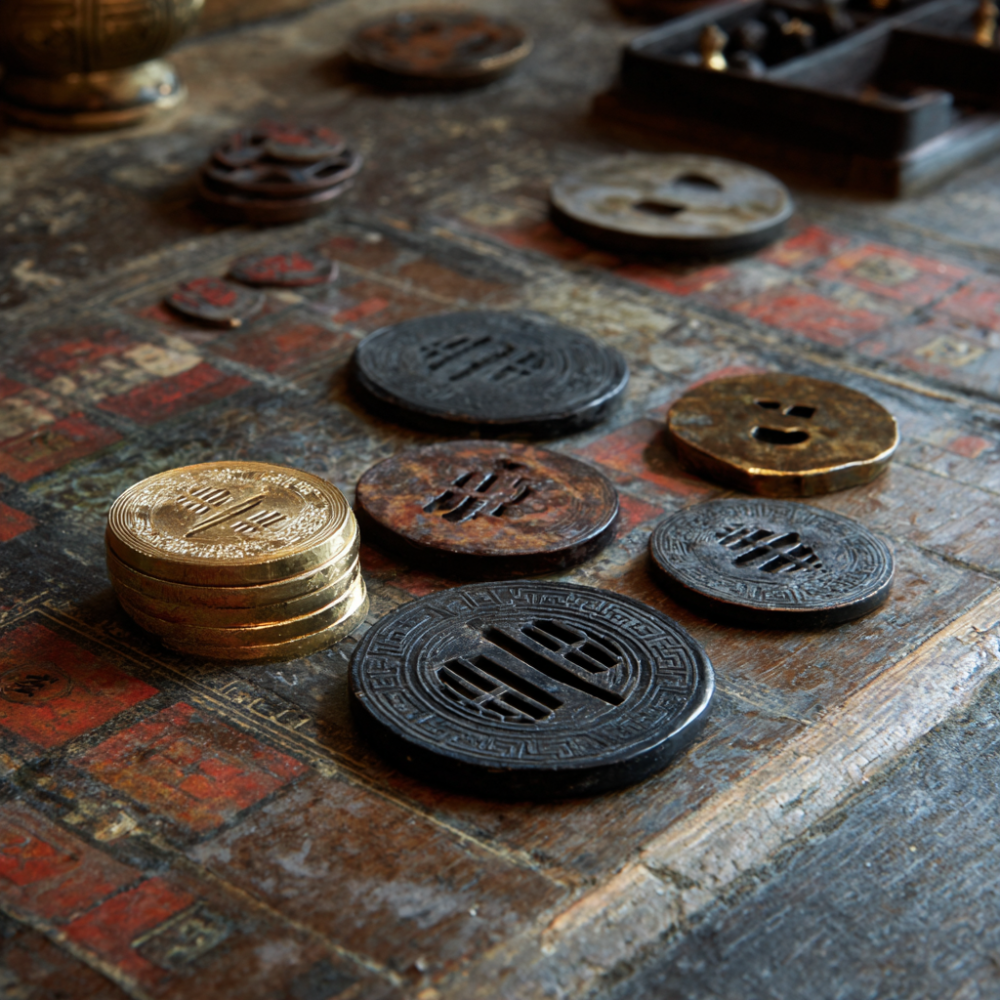
Whichever divination medium we choose to work with, whether it’s the Yijing, Tarot, runes, or any other oracle, we always begin in the same place: chaos. Chance. A moment that appears unstructured, even arbitrary.
To the ordinary mind, this is unsettling.
How can something like this be reliable?
How can meaning emerge from what looks like coincidence?
But for a practitioner, experience rewires the question entirely.
Through practice, observation, and time, we discover that chance is not the enemy of meaning. It is its source. There is no clean divide between the questioner, the moment, and the symbol that appears. The casting of coins, the shuffle of cards, the fall of runes all occur within a living field of causes, sensations, intentions, timing, and unseen currents.
Chance is not external to us.
It is us. This is how we come into being.
Not as a poetic idea, but as a lived reality. Our nervous system, our attention, our pulse, our physical presence all participate in the ritual of divination. What appears is the reader’s version of reality, because reality itself is probabilistic, relational, and responsive.
Divination is one of the few human activities that engages with chaos constructively. It respects chaos as an essential part of creation, where Yin and Yang are inseparable and continuously transforming into one another.
From this respect, patterns emerge. When this is understood, the question is no longer whether divination is reliable. The real question becomes whether we are capable of interpretation. Whether our mind can process the language of the divination medium without distortion. Whether we are willing to recognise ourselves as part of the mechanism through which meaning arises.
So what do we learn when we study divination?
We learn to place our attention at the crossroads of reality, the divination medium, and consciousness itself. We train the ability to perceive without interference, to think without warping what is seen.
© Master Anna